Last updated: September 15, 2026
Available with any of the following subscriptions, except where noted:

-
 Seats required for certain features
-
Additional subscriptions required for certain features
Use billing to request payment from buyers on a one-time or recurring basis. Depending on your subscription and account configuration, you can bill your buyers using invoices, payment links, quotes, or subscriptions. The billing behavior differs depending on which tool you use and your account configuration. Use this article to determine which billing option best fits your needs.
Billing options
-
Bill a buyer once: request a one-time payment using invoices, payment links, or quotes.
-
Bill a buyer repeatedly: send recurring invoices to buyers to request payment. Payments can be made by the buyer on each billing date, or collected automatically.
One-time billing
Subscription required A Revenue Hub subscription is required to create quotes.
Seats required A Revenue Hub seat is required to create quotes.
For one-time charges, you can use one of the following tools depending on your sales process:
- Invoices: bill a customer directly for a one-time charge. Create and send an invoice to request payment. Select One-time invoice when creating the invoice.
- Payment links: collect a one-time payment without creating an invoice requesting a payment. An invoice will be sent to the buyer only when the payment is complete.
- Quotes and legacy quotes: send a quote to request or collect payment.
Learn more about creating invoices, creating payment links, creating quotes, and creating legacy quotes.
Recurring billing using contracts
Billing is configured in billing settings, or when directly creating a contract (BETA). Accepted quotes can also create contracts. When billing is enabled, the line items, billing start dates, payment terms, and payment collection settings are used to determine how the buyer is billed.
Learn more about contracts.
Recurring billing using invoices
When creating an invoice, select Create recurring invoices to set up a subscription that bills buyers on an ongoing basis. Subscriptions can be set to automatically collect payments on each billing date, to request payment from the buyer on each billing date, or to not have online payments available to allow payment via other methods (invoices can be manually marked as paid in these cases).
Learn more about creating subscriptions.
Recurring billing using payment links
When creating a payment link, add recurring line items to create a subscription that bills buyers on an ongoing basis. When a buyer makes the first payment using the payment link, the same payment method will be automatically charged on each billing date for the duration of the subscription.
Learn more about creating and sharing payment links.
Recurring billing using quotes
Subscription required A Revenue Hub a subscription is required to create quotes and use the Connected CPQ, Billing, and Payments beta.
Seats required A Revenue Hub seat is required to create quotes and use the Connected CPQ, Billing, and Payments beta.
Billing is configured in billing settings, or when creating a quote or legacy quote. When billing is enabled, the quote's line items, billing start dates, payment terms, and payment collection settings are used to determine what happens after a quote is accepted.
Depending on your account setup, an accepted quote can create:
- A contract.
- Invoices.
- Subscriptions.
- Payment collection schedules.
Billing with Connected CPQ, Billing, and Payments
If the Automatically create contracts from accepted quotes setting is turned on and you're enrolled in the Connected CPQ, Billing, and Payments beta, a contract is automatically created when a buyer accepts a quote.
The contract manages ongoing billing, invoice creation, and payment collection. Payment is collected through invoices rather than directly through the quote. For quotes with line items with a recurring billing frequency, such as monthly billing, payment collection is based on the collection process set in your billing settings:
- Automatic collection: automatically charges invoices using the customer's payment method on each billing date.
- Manual collection: sends invoices on each billing date. The customer must manually pay each invoice.
To use subscriptions for recurring billing instead of contracts, turn the Automatically create contracts from accepted quotes setting off.
Learn more about managing end-to-end revenue in HubSpot.
Billing without Connected CPQ, Billing, and Payments
If you're not enrolled in the Connected CPQ, Billing, and Payments beta, payment collection remains tied to the directly created contract (BETA), quote, or legacy quote. Learn more about recurring billing using contracts.
Quotes: if the Automatically create contracts from accepted quotes setting is turned off, invoices and subscriptions are automatically created when the quote is accepted. The payment method entered at checkout is charged automatically on each billing date. If the Automatically create contracts from accepted quotes setting is turned on, billing can't be turned on.
Legacy quotes: for recurring line items, a subscription is auotmatically created and bills buyers on an ongoing basis. Subscriptions can be set to automatically collect payments on each billing date, to request payment from the buyer on each billing date, or to not have online payments available to allow payment via other methods (invoices can be manually marked as paid in these cases). An invoice is created separately for one-time line items.
Learn more about managing subscriptions.
Billing options
The following billing options determine when buyers are charged and when invoices are due.
Billing schedules and future payments
Billing start dates determine when buyers are charged for line items. By default, billing starts on the effective date of the payment link, quote, or subscription. You can also set a custom billing start date or delay billing by a number of days or months.
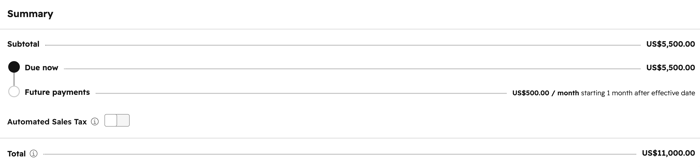
The summary of the payment link, quote, or subscription shows how the buyer will be charged:
- The Subtotal includes only items due at checkout.
- Items charged at a later date appear in the Future payments total.
- All items, regardless of payment due date, are included in the Total.
Payment terms
Payment terms determine when invoices are due. Invoices can be due on receipt or use net payment terms. If a net payment term is selected, each invoice is due a set number of days after its invoice date.
Next steps
- Learn more about viewing and managing contracts.
- Learn more about managing invoices.
- Learn more about creating and sharing payment links.
- Learn more about viewing and managing subscriptions.