
Last updated: April 2, 2026
Available with any of the following subscriptions, except where noted:
-
 Marketing Hub
Professional, Enterprise
Marketing Hub
Professional, Enterprise
Measure how your brand appears in answer engine responses using Answer Engine Optimization (AEO). After confirming brand details, such as the ideal customer profile and products, prompts are tracked on an ongoing basis to evaluate brand visibility across supported answer engines.
AEO runs your prompts daily against answer engines (e.g., ChatGPT), then aggregates results into visibility metrics. These metrics support analysis of brand mentions, prompt coverage, and citation patterns over time
Please note: you can manage AI feature access in your AI settings and configure what data is shared. Review HubSpot's AI Trust FAQs and AI Model Cards for detailed information on AI security controls, data use, and compliance.
Permissions required Marketing Access is required to use AEO.
Set up AEO
Set up AEO for the first time by confirming your brand details, competitors, products, ICPs, and prompts.
- In your HubSpot account, navigate to Marketing > AEO.
- Click Get started.
- In the dialog box, enter your brand name in the Brand field (e.g., AcmeDemo).
- Enter your domain in the Domain field (e.g., acme-demo.test).
- Enter your brand name variations. Separate each variation with a comma (e.g., AcmeDemo, Acme Demo).
- Click the Business type dropdown menu and select an option (e.g., B2B).
- When finished, click Next.
Review competitors
Review competitors to compare your brand’s visibility against other companies in answer engine responses. Add or edit competitor names, domain, and brand name variations to improve accuracy. You can update competitors later from AEO settings.
- To edit a competitor, hover over the competitor name and click Edit. In the right panel, enter the competitor details and then click Save.
- To add more competitors, click Add more competitors. In the right panel, add the competitor details and then click Save.
- To delete a competitor, hover over the competitor name and click Delete.
- When finished, Click Track and add [#] competitors.
Review products and ICPs
Review products and your Ideal Customer Profiles (ICPs) to define the solutions and target audiences AEO tracks. Prompts are generated based on your selected product and ICP, so these selections determine how your brand’s visibility is analyzed. You can update products and audiences in your AEO settings.
- Select a product or click Add product. If you click Add product, enter the product details and then click Save in the right panel.
- Select an ICP or click Add ICP. If you click Add ICP, enter the ICP details and then click Save in the right panel.
- To add additional products or ICPs, click the Add more dropdown menu and select Add more products or Add more ICPs.
- When finished, click Continue.
Review prompts
Prompts are questions relevant to your business that people might ask answer engines (e.g., ChatGPT) when searching for brands or products.
After confirming your brand details, competitors, products and ICPs, a set of suggested prompts are generated. The prompts generated are based on your brand identity details you provided, and can be updated in your AI settings. For accounts with Marketing Hub Professional or Enterprise subscription, prompts are generated based on your business context.
- To edit a prompt, hover over the prompt and click Edit. In the right panel, edit the prompt details and then click Save.
- To generate more prompts, click the Add more prompts dropdown menu and select Generate with AI. An additional 8-15 more prompts will be added.
- To add more prompts manually, click the Add more prompts dropdown menu and select Add prompts manually. In the right panel, enter the prompt details and then click Save.
- When finished, click Add and track [#] prompts.
Analyze the AEO dashboard
Use the Dashboard tab to analyze your AEO performance, including brand visibility, prompts, domains, citations, and competitor benchmarks. You can also manage competitors directly from the AEO settings.
- In your HubSpot account, navigate to Marketing > AEO.
- Click the Dashboard tab.
- To filter the dashboard, click a filter dropdown menu (e.g., Date or Engine) at the top of the page and select your options.
- When finished, click Apply.

Brand metrics
Brand visibility is how often your brand is mentioned among the prompts you track. It also shows how answer engines interpret your brand based on public information on the web.
Brand visibility is analyzed on:
- Prompt coverage: the percentage of prompts where your brand appears at least once.
- Frequency across answer engines: whether your brand shows up consistently across different answer engines.
- Relative competitor presence: how often competitors appear in the same prompt results.
- Brand visibility: displays a percentage score on how often your brand appears in answer engine responses across tracked prompts.
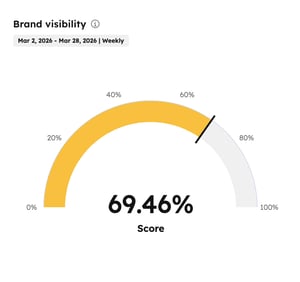
- Brand visibility over time: displays how your brand visibility score changes over time.
Review the following reports on the Sentiment analysis tab:
- Sentiment score: displays a score of how positively or negatively your brand is described in answer engine responses.
- Sentiment over time: displays how your brand's sentiment changes over time.
Competitor landscape
In the Competitor landscape section, review the following reports:- Share of Voice: the proportion of total brand mentions that belong to your brand across tracked prompts. This metric is calculated by dividing your brand's mentions by the total number of brand mentions from all competitors for the tracked prompts.
- Competitor Visibility: compares your brand identity to your competitors.
Citation analysis
In the Citation analysis section, review the following reports:- Top domains: displays websites that answer engines most often cite across your tracked prompts. If you click this report, you'll be directed to the Citations tab.
- Citations by channel: displays the channels of all citations for your tracked prompts.
- Citations with brand mention rate vs competitors: displays the percentage of sources cited by answer engines that mention your brand.
Analyze and manage prompts
Analyze prompts to understand how your brand appears in answer engine responses for products or services relevant to your business. AEO analyzes your prompts to confirm if your brand appears and which competitors are mentioned.
Prompts are generated using your HubSpot data, audience, and offerings. Update this information in your Brand settings.
Add and remove prompts on the Prompts tab. Prompt usage limits vary by subscription.
Analyze prompts
- In your HubSpot account, navigate to Marketing > AEO.
- Click the Prompts tab.
- To filter your prompts, click a filter dropdown menu (e.g., Date or Engine) at the top of the page and select your options.
- At the top of the view, review your prompt metrics including Total prompts, Average visibility, and Total responses, and Total citations. To hide metrics, click Hide metrics on the top right.
Understand the buyer journey stage
Each prompt is assigned a single buyer journey stage based on its intent. This classification helps interpret visibility metrics within the correct context.
The four Buyer Journey stages are:
- Awareness: broad, unbranded, problem-based queries where brand mentions are typically lower.
- Consideration: unbranded queries where users compare available solutions.
- Evaluation: branded comparisons that explicitly name your company or competitors.
- Decision: high-intent queries focused on deciding whether a specific product or company meets defined needs or features.
A prompt can only be associated with one Buyer Journey stage. This ensures reporting and visibility metrics are interpreted consistently. Changing the stage isn't recommended.
Manage prompts
- In your HubSpot account, navigate to Marketing > AEO.
- Click the Prompts tab.
- To add a new prompt, click the Add prompts dropdown menu and select Manually add prompts on the top right.
- To associate the prompt with an existing topic, select the checkbox next to each prompt you want to associate.
- Click Add topic at the top of the table.
- In the dialog box, click the Select topic dropdown menu and select a topic.
- When finished, click Add topic.
- To view details for a specific prompt, click the prompt. In the right panel, click the filter dropdown menu (e.g., Date range or Engine) and select an option. Review the following reports:
- Competitor visibility: how your competitors' brand visibility compares to yours over time.
- Prompt visibility rate vs competitors: shows a list of competitors comparing how much of the conversation your brand owns versus competitors.
- Citations by channel: show the percentage of channels with the most citations for your tracked prompts.
- To remove prompts, select the checkbox next to each prompt you want to remove and then click Delete. In the dialog box, click Confirm.
Analyze citations
Analyze citations to understand which websites answer engines reference, how authoritative your content appears, and whether third-party sources influence your brand’s visibility. Use this information to decide whether to update existing content or create new content.
A citation is recorded when an answer engine includes or references:
-
A link to a webpage
-
A domain name embedded in its answer
Please note: citations are separate from brand mentions. A source can be cited without mentioning your brand name.
- In your HubSpot account, navigate to Marketing > AEO.
- Click the Citations tab.
- To filter the dashboard, click a filter dropdown menu (e.g., Date or Engine) at the top of the page and select your options.
Owned domain citation rate vs. competitors
Use the Owned domain citation rate vs. competitors report to compare how often answer engines cite content from your website versus competitor domains across your tracked prompts.
A higher share of owned citations means answer engines rely more on content you control when generating responses. This gives you more influence over how your brand is represented in answer engines.
Review this report to:
-
Find trends in how often your owned content is cited over time.
- Compare your citation share against competitors for the same prompt.
- Find potential gaps where competitors are cited more often. This may show opportunities to improve the clarity, coverage, or relevance of your content.
If no data is shown, no citations were detected for the selected time range.
Citations with brand mention rate vs. competitors
Use the Citations with brand mention rate vs. competitors report to understand how often your brand is referenced in citations, regardless of where the cited content originates.
This report includes citations from third-party sources such as reviews, news articles, and industry publications. Even if answer engines don't cite your website directly, they may still reference your brand through external sources.
Review this report to:
-
Evaluate overall brand visibility in answer engine responses.
- Track changes in influence over time.
- Find when competitors are becoming more prominent for the same topics.
Citations by content type
Use the Citations by content type report to understand which content formats answer engines most often reference for your tracked prompts.
Content types include:
| Top lists and listicles | Blogs and news articles | Research and reports |
| Comparison articles | Documentation and technical docs | User reviews |
| Product pages | Wiki-style information pages | Social content |
Review this report to:
-
Find out which content formats answer engines prefer for your topic area.
- Find gaps where answer engines cite formats you don't produce.
- Prioritize creating or updating content formats that are more likely to earn citations.
Citations by channel
Use the Citations by channel report to view what types of websites answer engines reference when generating responses.
Source types include:
| Owned domains | Peer companies | Social platforms |
| Competitor sites | User-generated content | |
| Earned media | Affiliate sites |
Review this report to:
-
Understand how much of your brand visibility comes from content you control versus external sources.
- Find reliance on third-party validation such as earned or peer sources.
- Track growth in user-generated or social sources, which may show increased awareness or discussion.
Review additional citation reports
In addition to the above citation charts, review the following reports for insight into how answer engines reference your content and external sources:
- Top domains: lists the websites most commonly referenced by answer engines.
- Top owned citations: lists the pages on your domain that answer engines reference most often. This helps you understand which content answer engines consider most authoritative for your brand.
- Top citations overall: lists the websites that appear most often across all citations for your tracked prompts. This helps you understand which third-party sources most influence how answer engines describe your brand.
Use recommendations
Use the Recommendations tab to complete actions that may improve how often your brand is cited in answer engines. Recommendations are based on citation patterns across your tracked prompts.
After completing a recommendation, review changes in answer engine responses over time. AEO tracks the following:
-
Changes in brand mentions
-
Changes in visibility score
-
Changes in citation patterns
Answer engine responses change over time, so improvements may not appear immediately. Review results across multiple analysis cycles to evaluate impact.
Completed recommendations remain associated with the prompts they affect, allowing you to compare performance before and after changes.
Understand how recommendations are generated
For each tracked prompt, AEO analyzes answer engine responses and extracts all cited sources. Then AEO looks at patterns in those citations to find the structural and content signals most often linked to a citation.
Pattern analysis includes:
-
Frequently cited domains
-
Common content formats (e.g., blog posts)
-
Recurring themes and keywords
-
Competitor presence
Recommendations are generated directly from these observed patterns and reflect what answer engines consistently reference for your tracked prompts.
View and manage recommendations
- In your HubSpot account, navigate to Marketing > AEO.
- Click the Recommendations tab.
- On the Recommendations tab, click a recommended action.
- In the right panel, view the recommendation details:
- Suggested content: the suggested content to create. This includes the title, summary, target audience, and suggested keywords to use.
- What's driving this recommendation: the analysis that was completed on your citations for tracked prompts. This includes associated prompts, content type distribution, and top citations identified.
- To change the status of a recommendation, click the Change status dropdown menu and select a status (e.g., Mark as In Progress).
- To change the status of multiple recommendations, select the checkbox next to each recommendation. Then click the Change status dropdown menu and select a status (e.g., Dismiss).
Edit settings for AEO
Edit your brand name variations, competitors, products, and ICPs on the Dashboard tab.
-
In your HubSpot account, navigate to Marketing > AEO.
- On the Dashboard tab, click the settings icon on the top right and select an option (e.g., Edit Competitors or Edit brand name variations).
- Edit brand name variations: in the dialog box, enter your brand name variations and then click Save.
- Edit competitors: click the competitor's name. In the right panel, enter the competitor details and then click Save.
- To add a competitor, click Add more competitors. In the right panel, enter the competitor details, then click Add competitor.
- To delete competitors, select the checkboxes next to each competitor and click Delete [#] selected.
- View all ICPs: in the right panel, click Edit to customize an ICP. To create an ICP, click Create new Ideal Customer Profile.
- View all products: in the right panel, click Edit to customize a product. To add a product, click Add new product or service.