
Last updated: April 13, 2026
Available with any of the following subscriptions, except where noted:
-
 HubSpot Credits required for certain features
-
Additional subscriptions required for certain features
Loop Marketing is a four stage framework that helps marketers grow in the AI era. Unlike traditional linear marketing approaches, Loop Marketing is designed for a world where buyers research with AI, get answers before clicking, and discover solutions across scattered channels like TikTok and podcasts.
With Loop Marketing, marketers can use AI to become more efficient and drive better results through human-driven strategy and creativity, and AI-driven execution and optimization. When using the Loop Marketing framework, use Breeze to:
- Express your story: work with AI to create campaigns based on your objectives, informed by your brand style guide and ideal customer profile.
- Tailor your approach: build audience segments, enrich your data, and make content personal.
- Amplify your reach: build, optimize, and activate your content for humans and answer engines across channels like YouTube, social, ads, creator feeds, and more.
- Evolve your strategy: monitor real-time performance, run experiments, and tweak campaigns to match your needs.
Please note: you can manage AI feature access in your AI settings and configure what data is shared. Review HubSpot's AI Trust FAQs and AI Model Cards for detailed information on AI security controls, data use, and compliance.
Understand prerequisites
Subscription required A Starter, Professional or Enterprise subscription is required to use data enrichment.
Subscription required A Professional or Enterprise subscription is required to use brand identity, data agent, and buyer intent.
Subscription required A Data Hub Professional or Enterprise subscription is required to use Data Studio.
To effectively implement the Loop framework, complete the following foundational tasks.
- Set up Breeze Assistant: throughout the framework, Breeze Assistant will be used to generate insights and content. Suggested prompts will also be provided.
- Before getting started with Loop Marketing, you must set up Breeze Assistant and provide user permissions for the relevant tools. For example, to create campaigns in the express stage, users will need Campaign Edit permissions.
- It is also strongly recommended to create a custom assistant (BETA) for Loop Marketing and a knowledge vault (BETA) to provide any additional context on your brand.
- It is strongly recommended to review AI outputs throughout the process. Flagging any patterns of errors will help to refine your style guide and prompts.
-
Define your audience: use Breeze Assistant or the HubSpot Connectors for ChatGPT, Claude, or Gemini (BETA) to summarize CRM data from your highest-value customers to create an audience profile. This will be used when setting up your brand identity and reviewing your data layer.
-
Suggested prompt: tell me about our most successful customers. What are the biggest pain points that leads have expressed in their intake forms? Give me the history of our best deals.
-
-
Craft a style guide and use it in HubSpot: define a brand style guide to capture your unique branding and how it applies to your target audience. This will be your brand identity context. Input this into the brand identity tool. Then, when creating content with AI, brand-specific context including voice, tone, ideal customer profile, products, and competitive insight will always be applied.
-
Set up your data layer: to effectively generate content and tailor your messaging, set up the following tools to ensure that your data is unified. It is also recommended to audit your CRM data with your defined audience using a Breeze Assistant prompt.
- Tools to unify data: consolidate and complete your data with the following tools.
- Data Studio (BETA): consolidate your data from different platforms into HubSpot. You can also use datasets with other tools such as lists, workflows, and reports. Learn how to set up Data Studio.
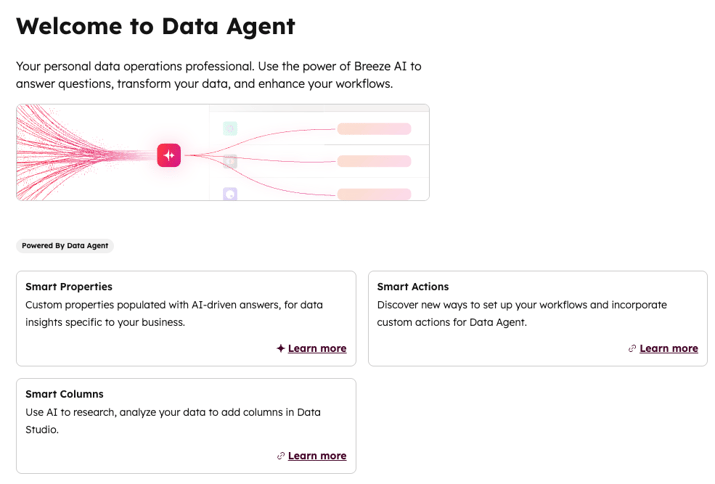
- Data agent: fill gaps in your CRM with custom enrichment, such as researching company information, enriching contact properties, and turning unstructured data from calls and notes into structured fields. Learn how to set up and use data agent.
- Buyer intent: set up buyer intent to identify leads based on active intent signals and target based on intent during the Tailor stage. Learn how to set up buyer intent.
- Suggested prompt: are my contacts currently effectively organized based on the characteristics, tiering, and signals from this audience [audience description].
- Tools to unify data: consolidate and complete your data with the following tools.
Express: define your campaign story
Subscription required A Marketing Hub Professional or Enterprise subscription is required to use marketing studio.
During this stage, define a campaign story based on an objective, rooted in your foundational context. At the end of this stage, you should have:
-
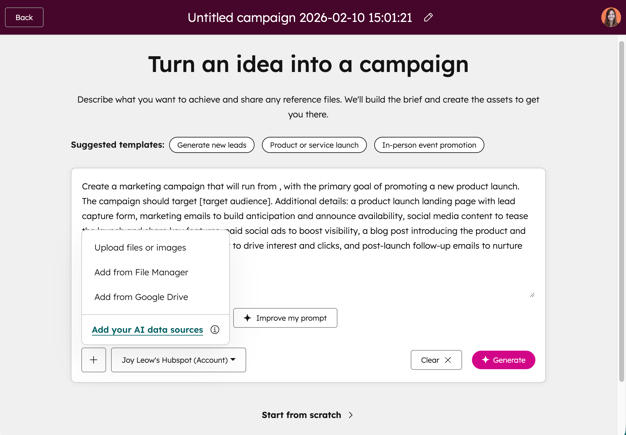
A campaign objective: the purpose of your campaign. For example, you can set an objective of generating new leads for a specific product during this campaign.
-
A campaign story: the story you want to tell based on your objective. This includes the key idea and messaging for this campaign.
-
Core asset: the asset that you're trying to drive traffic to, such as a playbook, a landing page, etc. In later stages, you can repurpose this to generate the campaign's supporting content and assets.
-
Campaign plan: a structured campaign, including timelines and planned channel activation, as well as desired outcomes based on the campaign objective.
To execute the Express stage in Loop Marketing, you will need to generate a campaign story, a core asset, and a campaign plan:
| Step | Description | Example prompt |
| Generate a campaign story |
Use Breeze Assistant to generate campaign ideas based on your objective, guided by your Brand Identity context. | Create three campaign ideas with key messages for our target customers [in target industry, with target persona]. List 5 ideas for content about our product and services." |
| Generate a core asset | Use Breeze Assistant to generate a core asset. | Create the core asset, or hero offer, for my campaign. My target audience is [persona/industry], my campaign objective is [goal], and my core message is [key theme or POV]. Generate the full asset including [format: guide, playbook, landing page copy, etc.]. |
| Plan your campaign |
|
Tailor: personalize your message
Subscription required A Starter, Professional or Enterprise subscription is required to use data enrichment.
Subscription required A Professional or Enterprise subscription is required to use data agent, buyer intent, and customer agent.
Subscription required A Marketing Hub Professional or Enterprise subscription is required to use AI-powered email.
Subscription required A Content or Marketing Hub Professional or Enterprise subscription is required to use the personalization tool and content variants.
During this stage, leverage behavioral signals, intent data, and contextual information to tailor messaging to your leads. At the end of the stage, you should have:
-
Audience segments with personalization logic
-
Dynamic content variations
-
Active agents on high-intent pages
When tailoring your content, it is strongly recommended to manually review your content for the following:
- Brand voice and tone should be kept consistent across all variations.
- Personalization feels natural and not overly familiar.
- Personalization and facts used are accurate.
- Value propositions align with actual customer needs and segment.
- CTAs make sense for the customer or company's lifecycle.
| Step | Description | Example prompt |
| Target records by Intent | Use buyer intent to identify leads with active intent signals such as job postings, product launches. Then, use AI to generate filters and descriptions in segments. These segments can be used with content assets such as Marketing emails, ad audiences, and more. | Find contacts who have shown signs of buying intent in the past 30 days across our CRM, such as pricing page visits or email replies. |
| Enrich your customer data |
Gather additional behavioral signals, intent data, and contextual information. Use data enrichment to automatically fill in data, such as company size, industry, job title, and more. | |
| Use Data Agent to further enrich records. For example, you can prompt Data Agent for additional information, then populate these answers in CRM properties. This information can later be used for segments and personalization. | Research [example companies] and tell me: Are they actively hiring in [buying committee roles]? What's their likely tech stack? Have they mentioned any pain points or competitors in past CRM notes? | |
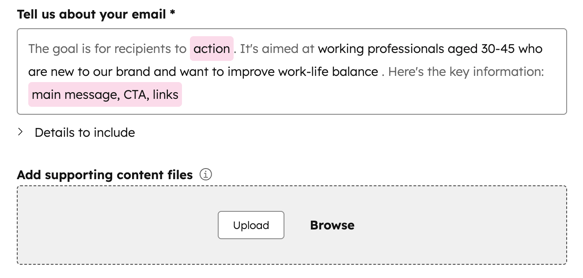
| Personalize your messaging | Use the personalization tool (BETA) to create and manage personalized content variants (BETA). Use smart content to personalize your marketing assets such as CTAs and landing pages based on your audience. You can also create marketing and automated emails using the AI email creation (BETA) to tailor outreach using CRM data and generate a personal email for each recipient. |
|
| Engage buyers on high intent pages | Set up customer agent on your highest intent pages such as pricing and comparison pages, to answer questions fast and increase likelihood of conversion. |
Amplify: deploy across diversified channels
Subscription required A Content Hub Professional or Enterprise subscription is required to use video clip agent and content remix.
Subscription required A Marketing Hub Professional or Enterprise subscription is required to use AEO.
During this stage, the goal is to be discoverable and consistent messaging across a range of different channels. A t the end of the stage, you should have:
-
AEO-optimized content
-
Published multi-channel campaign assets (social, ads, video, etc)
-
Creator collaboration content
| Step | Description | Example prompt |
| Optimize your content for answer engines | Use the AEO tool (BETA) to track your brand's visibility across answer engines like ChatGPT, Perplexity, and Gemini. Compare your performance against competitors, understand which sources are being cited, and act on prioritized recommendations with content briefs. |
|
| Collaborate with trusted creators | Partner with creators that your audience already follows and trusts. Use the HubSpot Connectors for ChatGPT, Claude, or Gemini (BETA) to identify high-intent, high-engagement partners within your industry that would be good fits with your brand. |
Which distribution channels and creator types are best aligned to reach [target audience looking for your specific product or service]? |
| Scale content production with AI |
Use the video clip agent to identify clips from your existing video library based on trending topics. You can also use the video editor to convert longer videos into short-form clips optimized for social platforms. | |
| Use content remix to easily create campaign assets for all channels from one core asset. You can use content remix directly from Marketing Studio. | ||
| Launch advertising | In HubSpot's ads tool, you can use AI when creating Google Performance Max Ad campaigns for smart distribution across search, social, and display. | Create a Google PMax campaign using [specific messaging]. Optimize for demo signups over 14 days. |
Evolve: optimize in real time
Subscription required A Marketing Hub Enterprise subscription is required to use email engagment optimization.
Subscription required A Marketing, Sales, or Service Hub Enterprise subscription is required to create a report with journey analytics.
During this stage, use AI to track performance and deliver real-time recommendations. Use AI to spot early trends, run experiments, and continuously refine your strategy. At the end of this stage, you should have:
- Performance analysis and insights
- Campaign optimization recommendations (or new ones to start)
- Learnings documented for your next Loop cycle
| Step | Description | Example prompt |
| Simulate Campaign Outcomes | Use AI to predict results before launching. In Hubspot, use email engagement optimization (BETA) to predict which recipients are most likely to engage. Use this tool to optimize your send lists for engagement. | |
| Monitor in Real-Time | Create a report with journey analytics to analyze customer journey paths between key touchpoints. Identify where prospects drop off and which paths lead to conversions, then apply these insights to optimize your next iteration. | Which hook version resulted in the highest conversion rate for [target audience] in Segment A? Include analysis of form fills, time on page, and email click-throughs. |
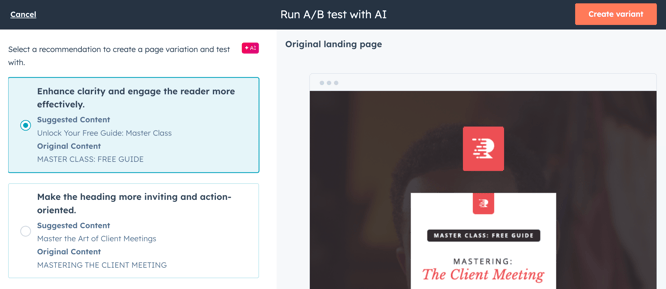
| Refine strategy continuously | Use Breeze Assistant to analyze the performance of your last campaign and make recommendations on what to change moving forward. Complement this with custom reports to track performance across assets, segments, and channels. Apply these learnings to refine your strategy for the next Loop cycle. Use Breeze-powered A/B testing (BETA) to generate suggested copy for your landing pages to discover what resonates most with your audience and create the most effective versions. |
Analyze the performance of our last campaign using the data from [specific timeframe]. Compare their performance across key metrics and recommend which approach to continue or update for better results. |
Frequently Asked Questions about Loop Marketing
Is Loop Marketing a product or feature in HubSpot?
No, it’s a framework that can be utilized with or without HubSpot. However, HubSpot provides a unified platform for executing the Loop Marketing framework.
When should customers use Breeze Assistant versus HubSpot’s Connectors for ChatGPT, Claude, and Gemini (BETA) in Loop Marketing?
Through the Loop Marketing framework, you can use either Breeze Assistant or HubSpot's connectors, or both, to execute tasks.-
Breeze Assistant: use Breeze Assistant for full context and memory of tasks within HubSpot. It is recommended to use Breeze Assistant when analyzing your customer profile and creating a style guide.
-
HubSpot’s Connectors: use these HubSpot's connectors when you want to use additional data from external sources. These allow you to take your HubSpot context into other AI tools.
Do I still need to focus on SEO when using Loop Marketing?
It is recommended to use both SEO and AEO in your content as part of a healthy and cohesive marketing strategy. Learn more about the differences between SEO and AEO.
What are the differences between SEO and AEO?
| SEO | AEO | |
| Goals | Be part of top 5 links | Be part of the presented answer |
| Strategies | Use keywords, backlinks, meta tags to rank | Use statistics, quotations, high authority sources |
| Rewards | Rewards domain reputation | Rewards repetition across trusted sources |
| Optimize | Optimize for website visits and volume | Optimize for AI visibility and conversion |
Is Loop Marketing replacing Inbound Marketing?
No, it is a way to bring Inbound Marketing into the age of AI. It remains true to the principles that made Inbound work: educating customers, creating value, and building relationships. The difference is in the ways marketers need to deliver on these principles.
Does Loop Marketing replace the funnel?
Loop Marketing is a framework designed to drive momentum in the funnel. It brings your funnel into the AI era, but it is not a funnel itself.