
Last updated: September 16, 2026
Available with any of the following subscriptions, except where noted:

-
 Additional subscriptions required for certain features
Summary
Use Breeze Assistant, HubSpot's conversational AI assistant, to generate content, summarize records, prepare for meetings, and complete tasks across your HubSpot account on desktop. Save prompts for repeated requests, organize related conversations into projects, and store preferences as memories so Breeze Assistant generates more consistent and relevant responses over time. In this article, learn how to start chats, add context to your prompts, manage memories and artifacts, and explore ways to use Breeze Assistant across sales, marketing, and service workflows.
For an overview of configuring your account for AI features, review how to set up a HubSpot account to adopt AI features.
Please note: you can manage AI feature access in your AI settings and configure what data is shared. Review HubSpot's AI Trust FAQs and AI Model Cards for detailed information on AI security controls, data use, and compliance.
Understand requirements to use Breeze Assistant
- Turn on Give users access to Breeze Assistant in your AI settings.
- Confirm features that depend on connected accounts, apps, or projects are set up on the desktop first to use them. For example:
- Confirm your calendar is connected to prepare for meetings.
- Connect apps to Breeze Assistant to use apps. Learn more about using Breeze Assistant with connected apps.
- Learn more about creating and managing projects to use projects.
- User permissions determine which actions can be performed with Breeze Assistant.
Understand limitations & considerations when using Breeze Assistant
- Breeze Assistant content generation is limited to 30 times each minute and 1,000 times each day.
- Connected app (e.g., Gmail) searches don't support natural language filters. For example, when searching Gmail, use the Gmail search query m:john is:unread older_than:1m instead of Give me any unread emails from John from last month.
How to use Breeze Assistant in HubSpot
Use Breeze Assistant to start a chat, add context to your request, and interact with responses.
How to start a chat with Breeze Assistant
- In the top navigation bar, click Breeze Assistant.
- Enter your prompt, click a suggested prompt, or use a saved prompt, and then click the send prompt icon to send a chat.
- If you've connected your calendar, you can prepare for upcoming meetings by clicking the Meetings card.

How to add context to your prompt in Breeze Assistant
- To use new or existing files:
- In the prompt text field, click the use tools icon.
- Hover over Add files, then select an option:
- From computer: your system file picker will open. Select the name of a file. Learn more about the supported file types and sizes.
- From HubSpot: the HubSpot files tool will open in the panel. Select the name of a file.
- To use connected apps:
How to manage chats and prompts in Breeze Assistant
- In the top navigation bar, click Breeze Assistant.
- Click the Breeze dropdown menu, then select New chat.
- To use a previous chat conversation:
- Click the Breeze dropdown menu, then select Chats.
- Click the name of the conversation you want to continue.
- To use a saved prompt:
- In the prompt text field, click the use tools icon.
- Hover over Saved prompts, then select a prompt.
- To save a prompt:
- Hover over a chat you sent.
- Click the three horizontal dots icon, then select Save prompt.
- Enter a name for your prompt.
- Click Save.
How to share artifacts in Breeze Assistant
Artifacts are saved outputs, such as HTML pages or text documents, that you can access outside of a single conversation. Share all artifact types with other users in your HubSpot account or publicly share PPTX or HTML artifacts via a read-only URL link.
To share an artifact:
- In the top navigation bar, click Breeze Assistant.
- Click the Breeze, then select Artifacts.
- Click the artifact you want to share.
- In the artifact viewer panel, click the open share menu icon, then select Share.
- In the dialog box, choose how to share the artifact:
- To share the artifact with other users in your HubSpot account:
- Click the Add people dropdown menu, then select a user or a team. You can also select Everyone at your company.
- Click Copy link to share the link with added users or teams.
- To share the artifact publicly:
- Toggle the Public access switch on.
- Toggle the Require password switch on to optionally require a password.
- In the Set a password text field, enter a password.
- In the URL text field, click the
copy URL icon to share the publicly available URL.

- Click Done when you're finished.
After an artifact is shared within your HubSpot account, users can access the artifact in Breeze Assistant. To make changes to the artifact, click Remix to create an editable copy. External recipients can open the URL in a browser without logging in. If a password is set, they must enter it to view the artifact.
How to work with Breeze Assistant responses
- In Breeze Assistant responses, there may be additional actions you can take, such as summarizing an associated activity. Click an action (e.g., Summarize) to send the prompt.
- Click the copy message icon below the message to copy a response.
- To provide feedback about a Breeze Assistant response:
- If the answer was what you expected, click the thumbs up icon.
- If the answer wasn’t what you expected, click the thumbs down icon.

- When Breeze Assistant needs clarification, a question card may display in the chat.
- To answer the question, select one or more predefined options or enter a custom response. Then click the send prompt icon.
- If multiple questions are required, click Previous and Next to move between question cards. Click Skip to skip a question.
- To view the context used in a Breeze Assistant response:
- In the top right, click the expand icon to change to the full-screen view.
- Click the expand right sidebar icon. In the right panel, the context that Breeze Assistant used is displayed, along with any files attached, artifacts created, or connectors used.
- To view more details about a specific piece of context, click the link.
- To view all of the context Breeze Assistant can access, click Context home.

How to manage stored memories in Breeze Assistant
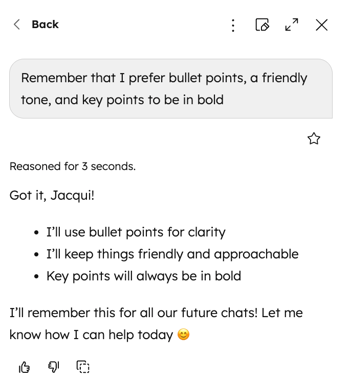
Breeze Assistant can remember important information about a user, like their name, job title, tone, writing style, and recurring instructions. Storing this information allows Breeze Assistant to provide more personalized responses over time.
- In the top navigation bar, click Breeze Assistant.
- Enter details that you want added or removed from Breeze Assistant's memories, then click the send prompt icon. For example, you could instruct Breeze Assistant to remember that you prefer bullet points or forget that you use a friendly tone.
- Click the Breeze dropdown menu, hover over More, then select Memories.
- Click the delete icon next to a memory to delete it.
What prompts can I use to reference past conversations for context
Breeze Assistant can search previous conversations for context. This allows for continuity across chats without manually re-entering context.
Conversation history is turned on by default. When relevant, Breeze Assistant may automatically reference previous chats to provide more accurate responses.
To reference past conversations manually, ask Breeze Assistant using natural language. For example:
Find all information in our past conversations about [subject].
Can you find out conversation about [subject]?
Repeat the approach you used last time [task].
How do I review the sources for Breeze Assistant's responses
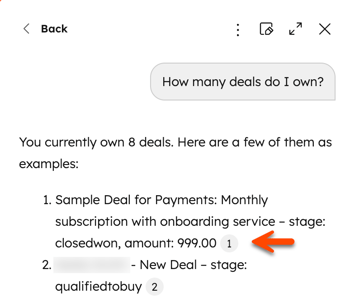
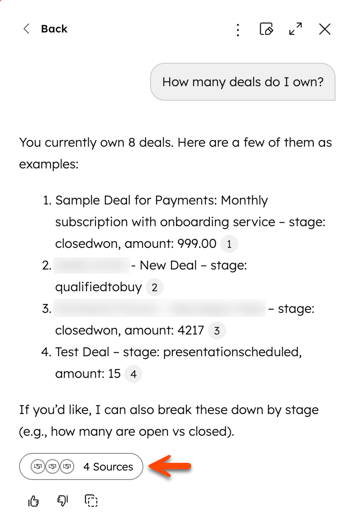
Breeze Assistant may include citations in responses to show where information came from, such as records, connected apps, and saved memories. Use citations and the Sources section to review what Breeze Assistant referenced when generating a response.
- In the top navigation bar, click Breeze Assistant.
- Enter your prompt, click a suggested prompt, or use a saved prompt, and then click the send prompt icon.
- Hover over the [#] citation and view the popover to view an individual citation. If you click the citation, you'll be directed to the individual record, connected app, or saved memory.
- Click [#] Sources below the response to review all referenced sources and memories for a response.
What are the different ways I can use Breeze Assistant?
Subscription required
- A Professional or Enterprise subscription is required to create an agent or use workflow.
- A Service Hub Professional or Enterprise subscription is required to summarize feedback survey responses.
- A Revenue Hub Professional or Enterprise subscription is required to generate quotes and use tiered pricing for a product.
Breeze Assistant can be used across different tools and workflows in your HubSpot account, depending on the task you want to complete. For example, Breeze Assistant uses HubSpot Academy content, website analytics, and Loop Marketing guidance for marketing related questions.
The following examples highlight common ways to use Breeze Assistant for sales, marketing, and CRM management tasks. Learn more by reviewing the HubSpot Use Case Library.
Where can I learn more about Breeze Assistant?
To learn more about specific Breeze Assistant features: